Answering the Toughest Questions About Suffering and Evil by Bruce Bickel & Stan Jantz
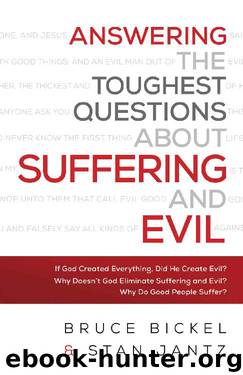
Author:Bruce Bickel & Stan Jantz [Bickel, Bruce]
Language: eng
Format: epub
Tags: REL067030, REL012000, Christianity and Culture
ISBN: 9781441231154
Publisher: Baker Publishing Group
Published: 2017-09-04T16:00:00+00:00
Incalculable Suffering
Even though they took place in another place and another time, stories like the one from Martyrs Hill elicit feelings of grief and sadness. We have not been to Japan’s Ground Zero, but we have experienced two other sobering reminders of the evil in our world: the 9/11 Memorial and Museum in New York City, and the haunting Holocaust memorial in Jerusalem known as Yad Vashem. Both of these places are designed to tell the stories of human suffering that occurred as a result of horrific events—so that we don’t forget what happened. We don’t possess Makoto Fujimura’s ability to express in words or in art the effect of these encounters on our senses, but we know how it feels to witness the ghastly experience of innocent lives taken by forces they never expected.
Mako’s description of “incalculable suffering” seems right. We can’t know, we can’t measure, and we can’t imagine what it’s like to be treated like the men and children crucified for their beliefs on Martyrs Hill. It would be one thing if such unspeakable cruelties were a thing of the past, but we know that’s not the way it is. Incalculable suffering is happening now, in our time, in our world. We can’t imagine what it was like for those twenty-one Egyptian Coptic Christians who were lined up and beheaded because they refused to renounce their faith in Christ. We agonize when we hear about hundreds of schoolgirls kidnapped in Nigeria by terrorists who enslave them for months if not years.
By God’s grace or sheer determination (or maybe a little of both), we seem better equipped to handle the suffering in our own lives, whether it happens to us personally or to a friend or family member. Because we’re close to it, we have ways of dealing with the pain. We don’t often feel helpless because hope is ever present. We may ask God why something is happening to us, but through experience and faith we accept our circumstances—though we usually don’t understand why.
But this matter of innocent people suffering—that is something very different, and it’s tough to deal with. Often the pain we feel for others is greater than the pain we feel for ourselves. Like the girl on the plane, we want to know why God didn’t stop the shooter in Orlando, or why he didn’t prevent the Boko Haram kidnappers or the ISIS beheaders from doing their evil deeds. Why doesn’t God stop the slaughter of the innocents?
We get it. We feel what you feel. But then we have to ask ourselves another more personal question: Why doesn’t God stop us?
Huh? Where did that come from! Well, we already introduced this idea in chapter 3, thanks to Joni Eareckson Tada: “If God being good means that he has to get rid of sin, it means he would have to get rid of sinners.” You probably caught on to the stark implication of that statement, but then dismissed it. It’s easy to rationalize that yes, we’re sinners, but we don’t crucify, behead, or enslave people.
Download
This site does not store any files on its server. We only index and link to content provided by other sites. Please contact the content providers to delete copyright contents if any and email us, we'll remove relevant links or contents immediately.
The 5 Love Languages: The Secret to Love That Lasts by Gary Chapman(9782)
The Space Between by Michelle L. Teichman(6927)
Assassin’s Fate by Robin Hobb(6197)
Wiseguy by Nicholas Pileggi(5766)
Everything Happens for a Reason by Kate Bowler(4729)
Gerald's Game by Stephen King(4639)
Pillow Thoughts by Courtney Peppernell(4271)
A Simplified Life by Emily Ley(4156)
The Power of Positive Thinking by Norman Vincent Peale(4053)
Harry Potter and the Prisoner of Azkaban (Book 3) by J. K. Rowling(3346)
Resisting Happiness by Matthew Kelly(3336)
Girl, Wash Your Face by Rachel Hollis(3275)
Being Aware of Being Aware by Rupert Spira(3272)
The Code Book by Simon Singh(3175)
The Secret Power of Speaking God's Word by Joyce Meyer(3165)
More Language of Letting Go: 366 New Daily Meditations by Melody Beattie(3017)
Real Sex by Lauren F. Winner(3006)
Name Book, The: Over 10,000 Names--Their Meanings, Origins, and Spiritual Significance by Astoria Dorothy(2976)
The Holy Spirit by Billy Graham(2942)
